Why Should Google Have the Best Car If It Owns the Road?
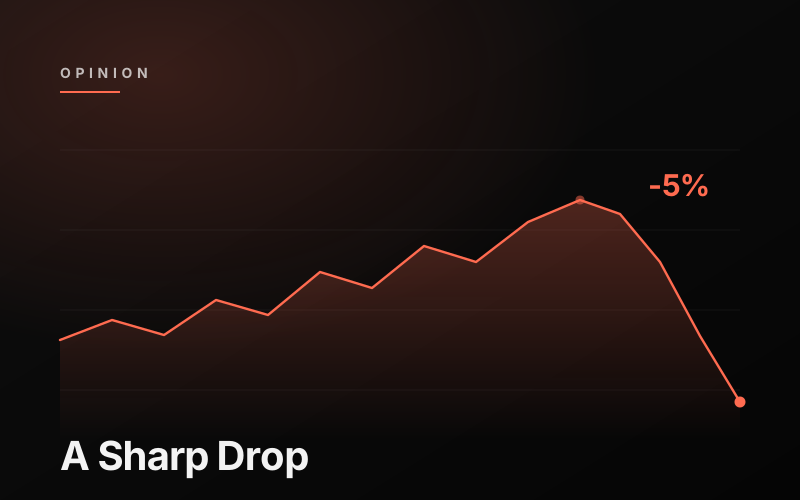
Google sold off 5% on a delayed Gemini 3.5 Pro, and the market read it as Google losing the AI race. But the capex isn't buying Gemini - it's buying Cloud, and the sell-off runs through a broken link.
Google sold off around 5% on the news that Gemini 3.5 Pro is being delayed, with the reporting pointing at underperformance on coding. The sell-off is the market saying, fairly explicitly, that it no longer believes Google is the AI winner.
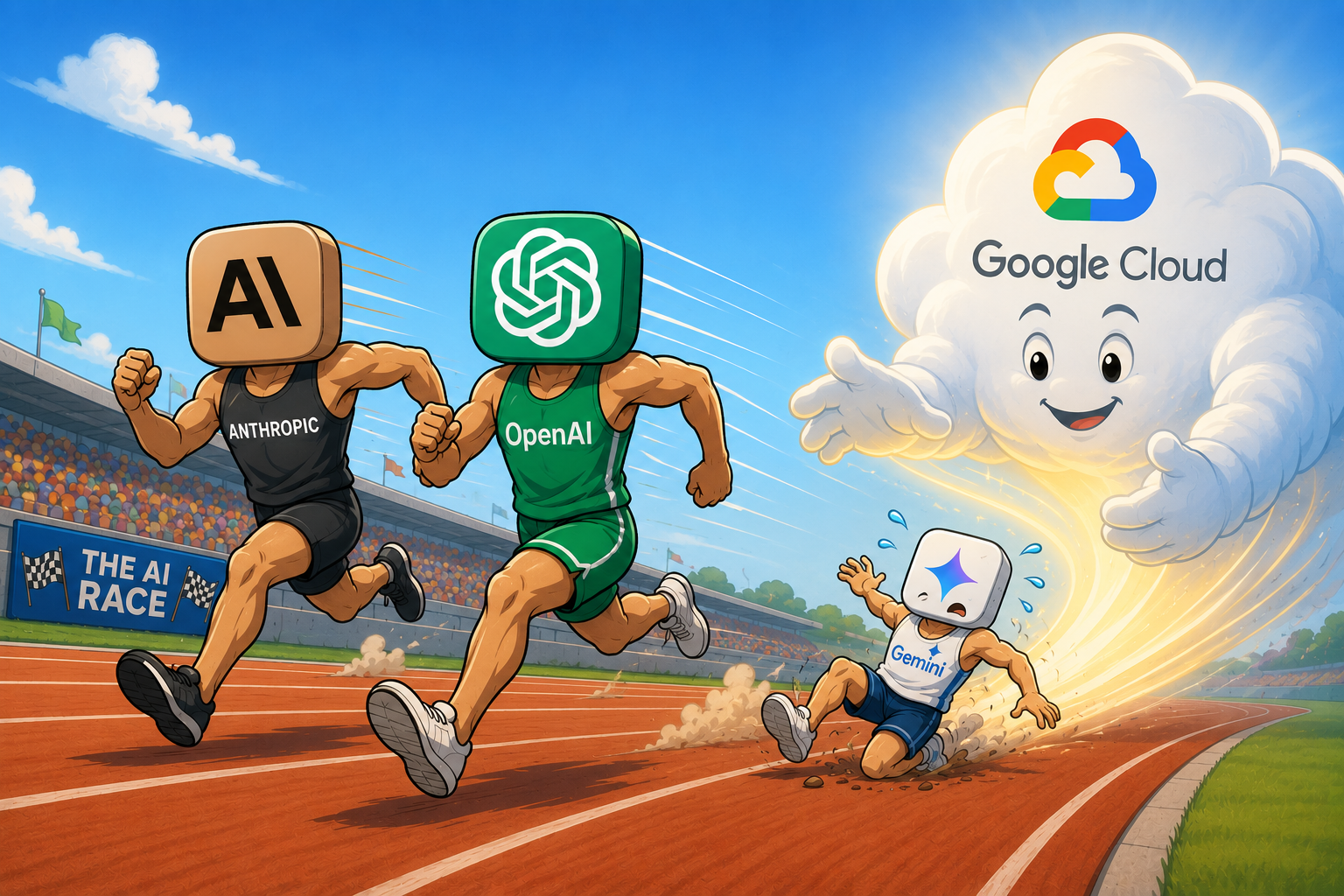
It didn't happen in isolation. 3.1 was underwhelming. The 3.5 Flash release was underwhelming. Senior people have been walking out of DeepMind, several of them to Anthropic, and the market didn't like that either. Now the model that was supposed to be the answer to all of it isn't arriving on schedule. Stack those together and you get a seemingly clear story: Google had the lead in AI, Google lost the lead in AI, and the worries about its capex spend seem to be confirmed.
I don't think that's the right read, and there are a few separate reasons why.
A delay is the correct decision here
Start with the delay itself. Look at what precedes it. Two releases have already landed below expectations. The third one would have come in just as weak, especially on the coding benchmarks that everyone is watching. What is the argument for shipping it anyway? Releasing a model that can't compete with the frontier of OpenAI and Anthropic gets you nothing. It hands the same people who wrote up 3.1 and 3.5 Flash a third piece to write, and it confirms the narrative rather than breaking it.
Holding it back is strategically correct. You risk the headline overreaction, but an underwhelming launch is a slow bleed that shows up in usage numbers three months later.
Nothing has been cancelled. This is not a failed model. It's a model that isn't ready, from a company that can afford to wait. And it's worth being precise about what it isn't ready for. The delay is on coding.
The comparison to OpenAI and Anthropic is the wrong one
That detail matters because coding is where the frontier race is being fought. This is where the benchmarks, the hype and the attraction lie. Claude Code is what took Claude from a well-regarded model to a revenue story. Codex is what brought ChatGPT's growth back on track. Those are not side products for either company. They are the growth engine, and both are pointed at it with something close to total focus.
Google has no equivalent. There is no Claude Code, no Codex. And I don't think it needs one. Between Claude Code, Codex, and the Chinese models climbing fast on the same axis, the coding market has no shortage of participants. Building a fourth entrant into the most contested segment in the industry is not an obvious use of Google's position.
So when Gemini 3.5 Pro slips on coding, the market reads it as Google losing a race. What I question is whether it should be part of that race in the first place.
Gemini is being measured the wrong way
I understand why it gets weighted so heavily. Coding ability drives enterprise adoption and it drives the general popularity of the tool. That's not in dispute, and it's precisely why Claude Code and Codex became the growth engines they are. But that logic holds for a company selling a model. Gemini isn't a model being sold into a vacuum. It sits inside the Google ecosystem, and that changes what good looks like.
The right frame for Gemini is something closer to Copilot, but better executed: a model that integrates seamlessly into a product mix that already exists and already has users. It doesn't need to be the thing people open a tab to go and use. It needs to be the thing running underneath the products they're already in.
Start with Search, because that is still Google's growth engine and the one thing that genuinely cannot be allowed to slip. The AI overviews in Search have been a real success. I've heard nothing but good things about them, and the reason is simple: you get the information you actually wanted, immediately, without having to click into three websites to find it.
Note what that use case demands. Speed. Nobody is going to sit and wait for Google Search. If Gemini is going to run underneath Google's product surface at Google's scale, latency is the binding constraint, not benchmark position. Which is exactly what 3.5 Flash was built for. Quick rather than top of the table, and intended to be the model behind Search for an enormous user base. Read as a frontier release, that's underwhelming. Read as the model that has to run inside Search, it's the correct design decision.
I don't see Gemini as a product that has to win on coding. Google doesn't need the best coding LLM. It needs the best LLM for its own product offering. One that sits inside the G-Suite, Search, YouTube and everything else Google has to offer. Yes, having a strong LLM on a stand-alone basis would be good (and what Google Gemini offers is definitely up there), but what I think is even more important is to have an AI system that enhances your product offerings to ultimately strengthen and protect them from the AI disruption caused by other models.
Should Google even want Gemini?
On top of all that, we know from Anthropic and OpenAI what running frontier LLMs actually costs. Inference at scale is expensive, and the coding use case is the worst version of it. Agentic work doesn't ask a question and take an answer; it runs for minutes or hours, holds context the whole way, burns tokens continuously. That's why token prices have gone in the direction they have. It's become expensive enough that businesses are actively looking for cheaper alternatives, which is the whole reason the Chinese open-source models are getting the traction they're getting.
And look at where the path to profitability runs. It runs through raising token prices. For now, that's the lever. But we've already seen what happens when you pull it: customers go and find something cheaper, and there is now something cheaper, and it's good enough. So the segment is expensive to serve, priced under pressure, and the one obvious fix accelerates the churn.
For Anthropic and OpenAI, that's not a choice. The LLM is the core business. There's nothing else. They have to be there, they have to win it, and they have to fund it by raising capital until the economics resolve. Google is not in that position. Eventually, Gemini can pay for itself in internal cost savings alone, as running its own model means it doesn't have to buy one from somebody else. And even if it ever wanted one from somebody else, nothing stops it. Google holds a substantial stake in Anthropic.
So why would you push with full focus into the most contested, most capital-intensive, least profitable part of the field, when it isn't your business, when it isn't your only business, and when the two companies that have to be there are burning capital to stay?
The capex isn't buying Gemini. It's buying Cloud.
The market is treating the delay as evidence that the capex spend isn't working. But the big bucks aren't going into building Gemini. It's going into data centres. It's going into Cloud. That distinction is everything, because Google Cloud does not rely on Gemini being the top frontier model. It's nice to have. Of course it is. Having your own top model to integrate gives customers a reason to switch to you or stay with you, and it gives you something to charge more for. But it is a feature of the offering, not the offering.
Microsoft doesn't have its own frontier model. Amazon doesn't have its own frontier model. Both run enormous cloud businesses off the back of AI demand regardless. You don't need to own the model to sell the compute it runs on. And Google has the cleanest route of anyone to filling that gap if it ever mattered. Either Gemini catches up or it leverages its substantial stake in Anthropic. There's a fairly obvious version of this where Google Cloud uses Anthropic's models and the question of whether Gemini or Claude is better becomes less relevant.
Which gets to the point I think is being overlooked. Take the Chinese models - the ones everyone is worried about, the ones businesses are moving to on price. The worry I keep hearing is Chinese influence in open-source models, which doesn't hold up. It's open source. You take the weights and you run them yourself. There's no channel for anyone to influence you. But look at what that sentence actually contains. You run them yourself. They have to run somewhere. Every model does. And especially if it's open weight.
So the thing the market is pricing as a threat to Google is, structurally, demand for exactly what Google is building. Whichever model wins - Gemini, Claude, GPT, some Chinese open-source model - it runs on someone's cloud. Same as Microsoft, same as Amazon. That shouldn't be looked at as a hope. It's an arithmetic property of the thing.
This is the same shape as the argument I made about software. AI doesn't reach a business directly; it reaches it through the software that already holds the workflow and the data. But run that one step further down. The software has to run somewhere too. Underneath the model layer and underneath the software layer, there is a compute layer, and it is the only part of the stack that gets paid regardless of which name above it wins. That's what the capex is buying. Not a benchmark position. A position as the thing AI has to be run on.
So the sequence the market has assembled - of Gemini being delayed and therefore the AI investment isn't returning - has a broken link in the middle. The AI investment isn't Gemini. Gemini slipping tells you very little about whether the data centres fill up, and the data centres are what the money goes into.
The sell-off is a short-term reaction to something that isn't the business
A model that wasn't ready didn't ship. That's the event. Everything stacked on top of it runs through a link that doesn't hold: Gemini's release schedule and Google Cloud's demand book are not the same variable. The backlog nearly doubled in a quarter to $462bn, half of it converting within 24 months. None of that is contingent on 3.5 Pro's coding benchmarks.
The setup underneath is improving. Semi-cap names have sold off hard, worries and hopes about memory prices are near their peak, and money is rotating back into other sectors. This makes Google's earnings report next week the thing to watch. Cloud grew 63% in Q1, and Pichai's line was that revenue would have been higher if they could have met demand. If the backlog is converting on schedule, the sell-off was noise. If it isn't, the bear case stops being about Gemini and starts being about something real.