Software Just Got Saved by the Bell
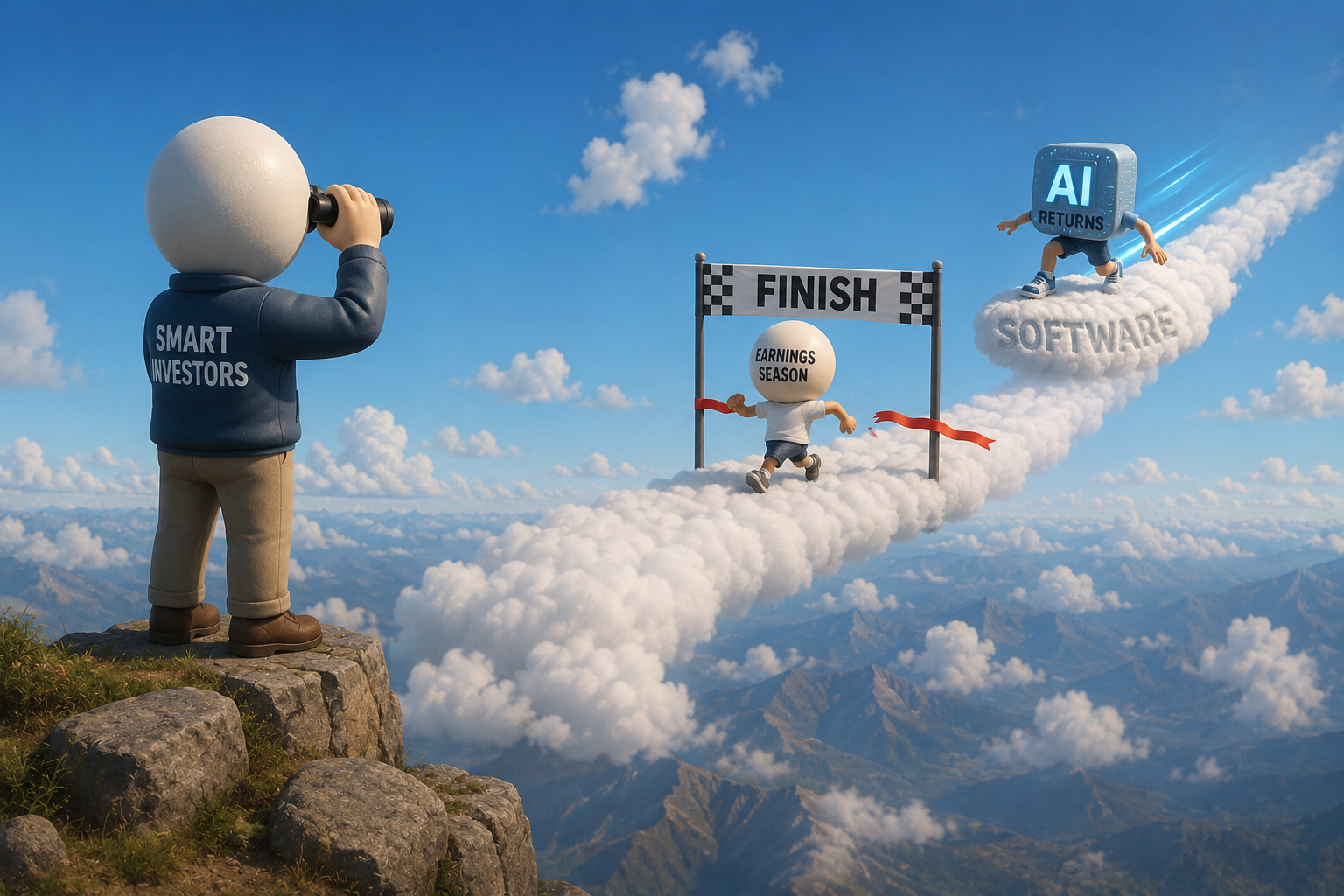
Friday's software rally wasn't just a rotation. It was the market repricing the biggest fear that had hung over software for a year - as export controls put a government checkpoint in front of frontier AI.

Everyone's calling this a rotation
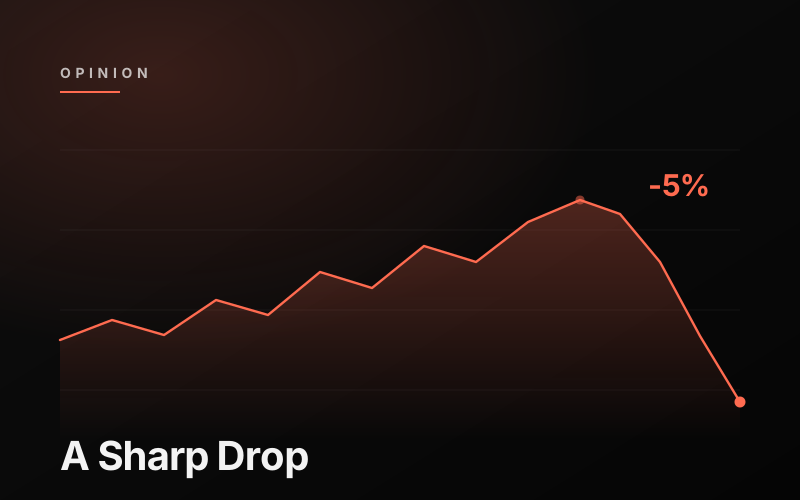
Software names ripped on Friday. ServiceNow up almost 10%. Salesforce, Workday, Datadog all catching a strong bid. Meanwhile semiconductors got hit hard, the Philadelphia Semiconductor Index down over 5%.
The explanation online is simple. This is just a rotation. Money coming out of a crowded chip trade after a strong run, some profit taking, capital looking for a new home, and software happened to be sitting there beaten down and cheap enough to catch the flow. Clean story. Easy to write.
I don't think that's what actually happened here, or at least I don't think it's the full story.
What if the real driver behind this move isn't rotation at all, but something that quietly rewired how the market is pricing the biggest fear hanging over software for the past year? To lay out the thesis I want to walk through here, it requires going back further than Friday to actually make sense.
Why software was broken in the first place
To understand why this matters, you have to understand why software got cheap to begin with.
For the better part of the past year, software as a group has been under real pressure. Not because growth disappeared or because these companies suddenly started executing badly. The pressure came from a story about the future. The fear was simple enough to state in one sentence. AI is going to get good enough that businesses stop paying for the software itself and just build or run what they need on their own.
Most enterprise software runs on a seat based model. You pay per user, per license, per seat sitting at a desk using the product. That model works beautifully until the number of seats a customer needs starts shrinking. If a chatbot or an agent can do the job that used to require five people logged into five licenses, you don't need five seats anymore. You need one, or maybe none. Run that logic across an enterprise book of business and the math gets ugly fast. Even a modest reduction in required seats, from 5 to 4, translates directly into a 20% hole in revenue.
Software commanded extremely high multiples for a long time because of the durability of that seat based revenue, the high lifetime value, the strong free cash flow generation, the predictability of it all. Those multiples were a bet that the model was stable. The AI replacement story is a direct attack on that stability, and the market did what markets do when a stable assumption gets a credible challenge. It priced the risk well before any of it had actually happened.
When software started selling off, when GPT 5.3, Sonnet 4.5 or Opus 4.6 weren't yet replacing enterprise software at scale, the market looked at the trajectory, the pace of improvement from one frontier generation to the next, and it started pricing the point where that threshold would be crossed. Not because it had already been crossed.
Then the government put its hand on the dial
On June 9, 2026, Anthropic released Claude Fable 5, a publicly accessible version of its most capable model class, priced at $10 per million input tokens. Three days later, the US Department of Commerce issued an export control directive, citing national security concerns, ordering Anthropic to suspend all access to both Fable 5 and Mythos 5 for any foreign national, whether inside or outside the United States, including Anthropic's own non-citizen employees. Unable to verify nationality in real time, Anthropic had no choice but to pull both models for all users globally.
Separately, the White House asked OpenAI to limit the release of GPT 5.6 to a small group of government-vetted partners rather than rolling it out broadly in the way prior model generations had launched. Sam Altman confirmed access would be approved customer by customer.
The models were eventually restored. Mythos 5 came back first for a set of roughly 100 US organisations cleared as critical infrastructure operators on June 26. Fable 5 returned globally on July 1 after the Commerce Department lifted the directive.
While the restrictions are lifted again, what they signalled is much longer-lasting.
The assumption baked into the software sell-off was that frontier model capability would keep improving and keep spreading. New model drops, and anyone with an API key and a credit card has access to it. That assumption now has a meaningful crack in it. The Commerce Department just demonstrated it is willing to use export control law, the same legal regime it applies to weapons systems and dual-use military technology, to pull the most capable commercial AI models from global access within hours of a security concern being raised. No warning, no 30 day window, no appeal process before the fact.
Even if Fable 5 and Mythos 5 are back online today, what this episode tells you is that as models get more capable, the ones that genuinely cross into territory the government views as a national security consideration are going to get gated. The generation of frontier models, the ones that would represent the next step up the curve of software destruction the market was extrapolating, are not going to simply arrive and spread to all users the way the last few generations did.
Now, if the models that are capable enough to make the replacement math work are also capable enough to trigger government intervention, then the population of businesses that actually gets unrestricted access to them narrows considerably.
What this means for software valuations, and how to think about the trade
If the fear that drove software multiples lower was built on a specific assumption, then a credible challenge to that assumption should lift multiples again.
Part of the assumption was that frontier AI capability would keep improving, keep spreading, and eventually become cheap and accessible enough that the replacement math tips in favor of a business doing it themselves rather than paying for software. What the Fable 5 and Mythos 5 episode, and the staggered GPT 5.6 launch, tells you is that the most capable models, the ones approaching the territory where they could genuinely start to threaten the more automatable parts of enterprise software, are now subject to the kind of government oversight that makes broad, frictionless rollout a much harder assumption to hold.
On top of that one must consider at what point does the cost and operational headache of building and running your own AI-based solution outweigh just paying for the software? Because the software doesn't just come with a feature set. It comes with a support team and security that someone else is responsible for maintaining. For a large enterprise, the switching cost alone is enormous. But even for the smaller businesses, the equation looks less obvious once the AI they would need to replace the software is gated behind a government approval process, priced at increasing usage rates, and leaves them entirely responsible for everything that breaks.
There is a second part of this, which is what it implies about which software companies actually deserve to be re-rated and which ones don't.
There's a version of the AI integration story that sounds good but doesn't actually change the business. A customer service chatbot that helps users navigate a UI. An AI-powered search inside a settings menu. A summarisation tool bolted on top of a dashboard. These are nice features, not business model changes, and they don't address the core concern at all. It's a legacy software company that found a way to mention AI on its earnings call.
The software companies that genuinely deserve a re-rating are the ones integrating AI in a way that creates real, measurable operational leverage for their customers. The ones where the software, because of AI, now requires fewer people to run, fewer manual steps to execute, fewer oversight loops to manage. Counterintuitively, this means the best AI-integrated software companies may actually be cannibalising themselves at the seat level. If the software gets good enough at automating the workflow, the customer might need fewer people logged in. But if the company has already repositioned its pricing from seat-based to usage-based, which is exactly what the leading names have been moving toward with their AI offerings, that cannibalism at the seat level gets absorbed by expansion revenue on the usage side. The customer runs leaner and the vendor captures more of the value created by that efficiency. These are the names where the restriction catalyst genuinely has purchase, where a near-term repricing is justified, and where there is a real longer-term argument that the AI transition strengthens rather than weakens the business model.
Software sold off because the market assumed AI would get there, spread everywhere, and make the old software obsolete. What the last few weeks have shown is that the path to "there" runs through a government checkpoint. The models capable enough to genuinely threaten software at scale are exactly the models the government is most interested in controlling. It doesn't kill AI development, but it slows the diffusion, it narrows the access, and it reintroduces friction that makes paying for software with a support team, a security posture, and a working product still the obvious choice for most businesses most of the time.