Earnings Season Arrived. Will AI Returns Do the Same?
The AI trade is priced for a story it hasn't proven. This is the season that either re-anchors the rotation to real earnings - or exposes it as money looking for a new home.
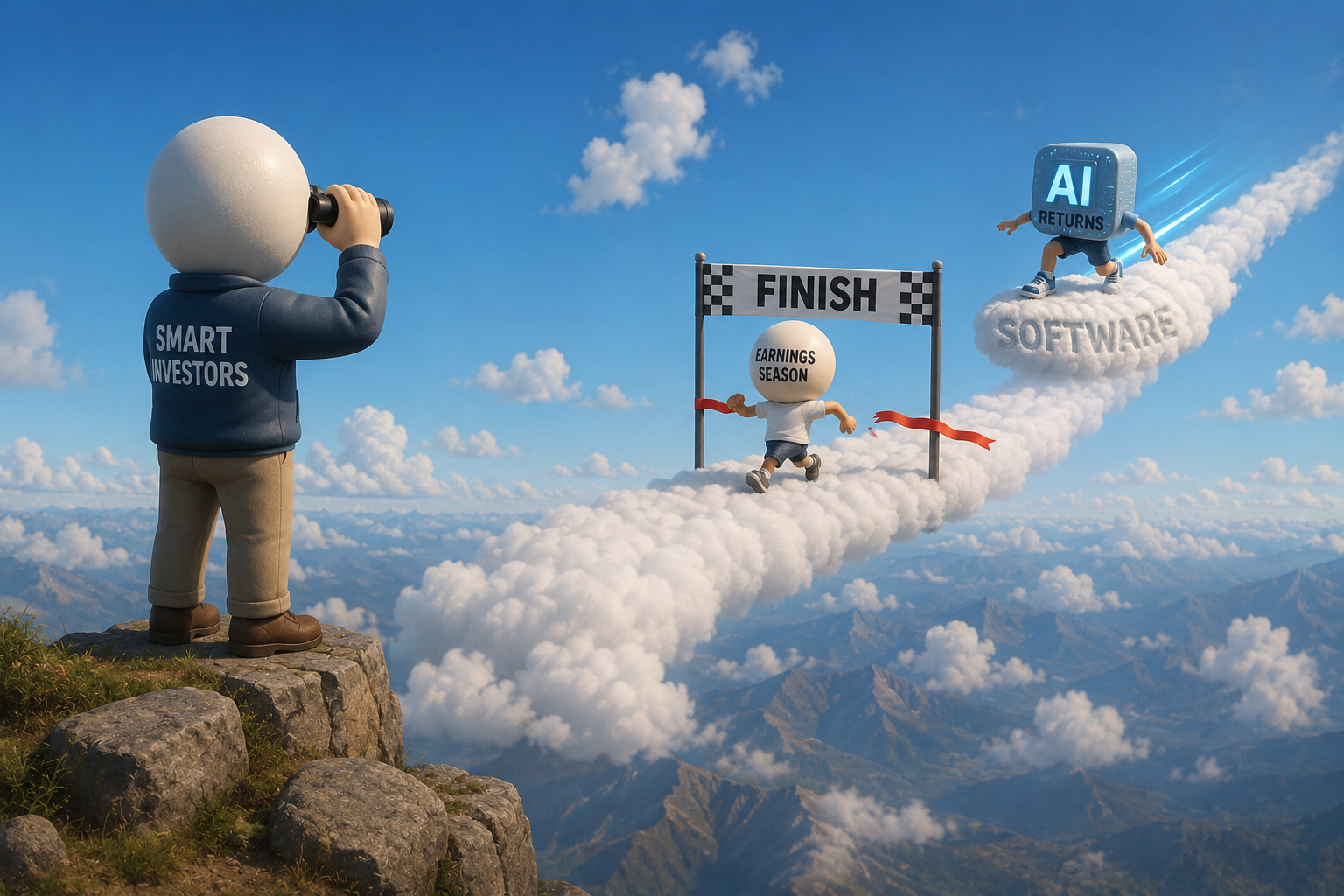
Earnings season arrives with the AI trade priced for a story it has not yet proven. More broadly, we have been seeing a rotation this year, which is doing much of the work holding the market up. On the days chips, memory and especially the hyperscalers sell off, the broadening is what keeps the tape green. The question is what that rotation is anchored to. The broadening names have re-rated on price and rotation and their multiples have expanded. Price has moved while the earnings base underneath it is still the old one. And those haven't shown returns from AI yet either, which could have helped the stocks.
That is what makes this season the relevant one. Either earnings come through and re-anchor those multiples to something the price can stand on, or they do not. This season decides whether the rotation was justified after the fact or just money looking for a new home (which will leave just as quickly as it did the hyperscalers before).
The hyperscalers are the main AI capex spenders, and the question for them is easy to state and harder to answer: is the spending finally showing a return? For the hyperscalers, the return shows up in cloud growth, so those are the numbers that matter most this season. The hyperscalers are spending at a rate that is compressing free cash flow this year and next, while the chipmakers they are buying from see their cash flows climb. That is a large bet to be carrying, and it pays if the cloud growth keeps coming.
Importantly, the hyperscalers are not laying out these billions to use AI just for themselves. They are building a platform for other people to use AI through their cloud. The capex is not just a bet on their own productivity lifting through AI; it is also a bet on everyone else's demand for AI and, ultimately, their returns from it. The hyperscalers are building the platform, and this season should really start to show whether anyone is actually going to continue standing on it.
Are the businesses seeing it?
The intended inhabitants of these platforms are the ordinary companies buying into AI to run themselves better. The tools have been in businesses' hands long enough now that a genuine improvement ought to be measurable by now. So the question for this season is simple: are these companies seeing it?
Now, if they are, then we can expect the next leg of the AI trade. Profit forecasts of the semis would allow for even more upside than they have already seen. There is still uncertainty around whether those profits will actually materialise and sustain when the time comes. That uncertainty would start to be priced out if we see the returns on AI come through.
If we don't see that, I think there are two potential explanations. Either AI is not good enough yet, and there are no real business applications behind the demos, or, the option that I think is more likely to be true, the tools are good enough but the businesses do not yet have the know-how to get a return out of them. The first would mean the whole trade is built on something that does not deliver. The second would mean returns will show up, just not through the companies' own effort.
The DIY approach isn't working
From my experience with AI, it is already good enough to at least deliver some quantifiable return in a lot of business settings. The problem sits on the other side of the equation. Companies are going straight to the source, plugging into OpenAI or Anthropic directly and trying to build the tools themselves, and the DIY approach is not working. The hard part is the data structure, integration, workflow and knowing what to point it at. And most companies just do not have that knowledge in-house.
Whether the AI returns show up or not, and especially the language around missing returns, is what I will look out for this season. If they are missing because companies cannot yet implement it themselves, the return is not gone. It is waiting for someone to unlock it.
The outsourcing layer is the real story
The largest players have stopped treating it as the customer's problem. Microsoft has put $2.5 billion and 6,000 industry and engineering experts into a new subsidiary, Microsoft Frontier Company, whose staff sit inside client organisations to design and run their AI systems for them. It is not alone. Amazon committed $1 billion to its own embedded-engineering initiative two days earlier, and both OpenAI and Anthropic launched comparable ventures in May, with OpenAI's venture backed by more than $4 billion. The framing across all of it is the same, and it is the enterprise-returns point stated by the companies themselves: the models are not the bottleneck; getting one to deliver inside a functioning business is. What they are all funding, in effect, is a layer that sits between the business and the model and does the part the business cannot do on its own.
This outsourcing layer is the real story, and forward-deployed engineers are only its most expensive version. Sending people into a client does not scale to the whole economy; the version that does is the software the business already runs. Going straight to the source, plugging into a model provider directly, is like being handed an engine and told to build the car yourself. Most companies do not know how to build a car.
Software is the car manufacturer
Software is the car manufacturer, and it sits in the middle, between the business and the model. It does the two things the business cannot do for itself: it guides the AI, because it already holds the workflow, the data and the context the model needs to be useful, and it enables it, by wiring the model into the tools the work already runs through. The AI does not reach the business directly. It reaches it through the software, shaped into something that fits how the business already operates. That is the position that matters, and it is why the demand for AI on the business side runs through software rather than around it.
The software that wins does not bolt AI on as a feature and leave its old self intact. It rebuilds the product around AI and monetises the usage that runs through it, turning what used to be a flat subscription into something that expands as customers lean on it. This is the argument this series has already made for why software survives AI rather than being eaten by it. The question now is whether the numbers are starting to show it.
Figma is the clearest live example. It kept its seat model and layered usage-based AI pricing on top, so once a customer exhausts the credits included with their seats, they keep paying to use the features, either through a credit subscription or pay-as-you-go at three cents a credit. That is the AI consumption being metered as it passes through the software, and it shows up where it matters, in retention: net dollar retention climbed from 125% at the start of 2024 to 136% by the end of 2025. Revenue is guided to grow around 30% in 2026. People keep using the AI offerings even when they have to pay extra for them. That shows real value. Existing customers are spending more each year with AI, not less.
This earnings season, I will be watching and should be able to see which software companies have added AI and now put usage and retention behind it the way Figma can. The names that can are the ones turning the AI theme into earnings; the ones that cannot are what the software bear case was really about.
The AI trade lives on
Ultimately, if companies report and AI efficiencies are not showing up in the broader market, I believe the returns will have to arrive through the software they already run. The LLM providers will naturally start running B2B2B business models. The hyperscalers' cloud platforms are still being used for AI, just by other people. The AI trade lives on.